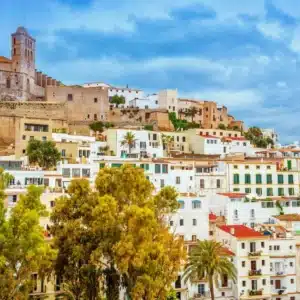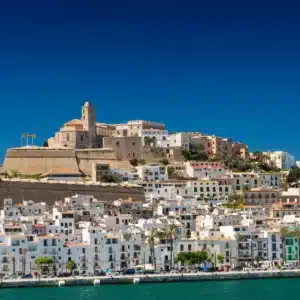

Rising above Ibiza Town, Dalt Vila is one of the island’s most recognisable landmarks. Declared a UNESCO World Heritage Site, this fortified old town is not only a historical monument but also a place best discovered slowly, step by step. Its stone walls, bastions, narrow streets and open viewpoints reveal how Ibiza has defended, transformed and redefined itself over the centuries.
Exploring Dalt Vila is not about rushing from one point to another. It is about following a natural route that combines history, landscape and atmosphere. These are the best corners of Dalt Vila, arranged in a logical walking order, allowing visitors to understand the old town while enjoying some of its most rewarding views.
Portal de ses Taules: the iconic gateway
The visit usually begins at the Portal de ses Taules, one of the main entrances to the walled city and one of the most photographed spots in Ibiza. This monumental gateway once controlled access to Dalt Vila from the port and remains an impressive introduction to the old town.
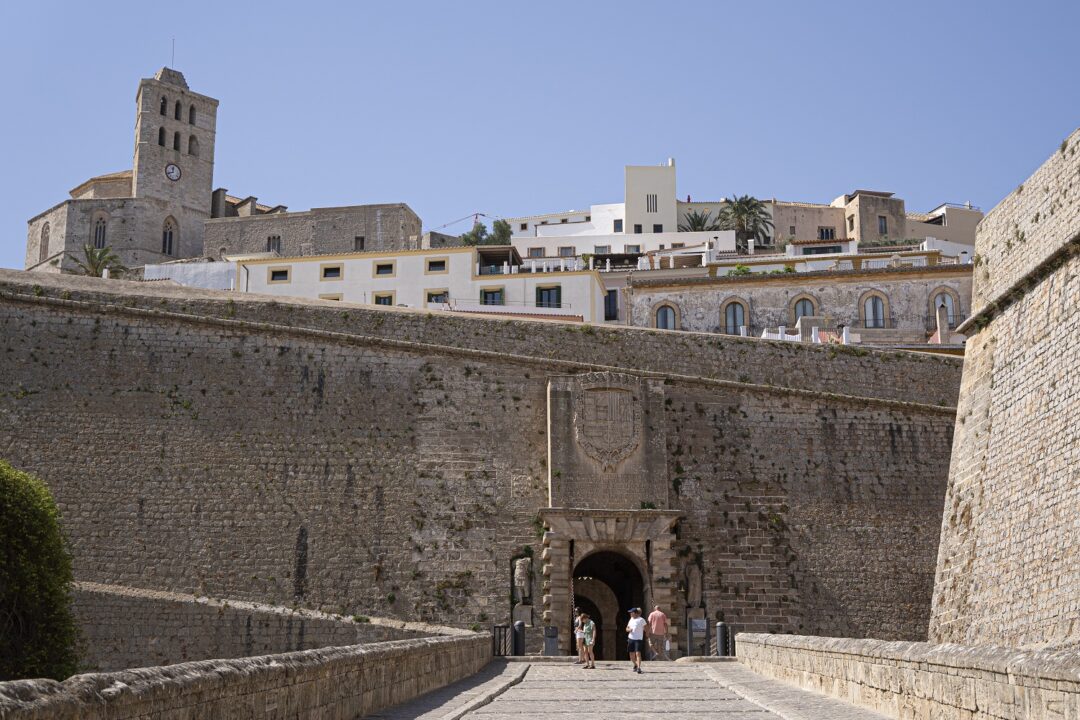
From here, the view frames the cobbled street climbing uphill, with the Marina and harbour behind. Passing through the portal feels like crossing from the lively lower town into a quieter, historic space.
It marks the transition into Dalt Vila and offers one of the best photo opportunities in Ibiza.
Museu d’Art Contemporani d’Eivissa (MACE)
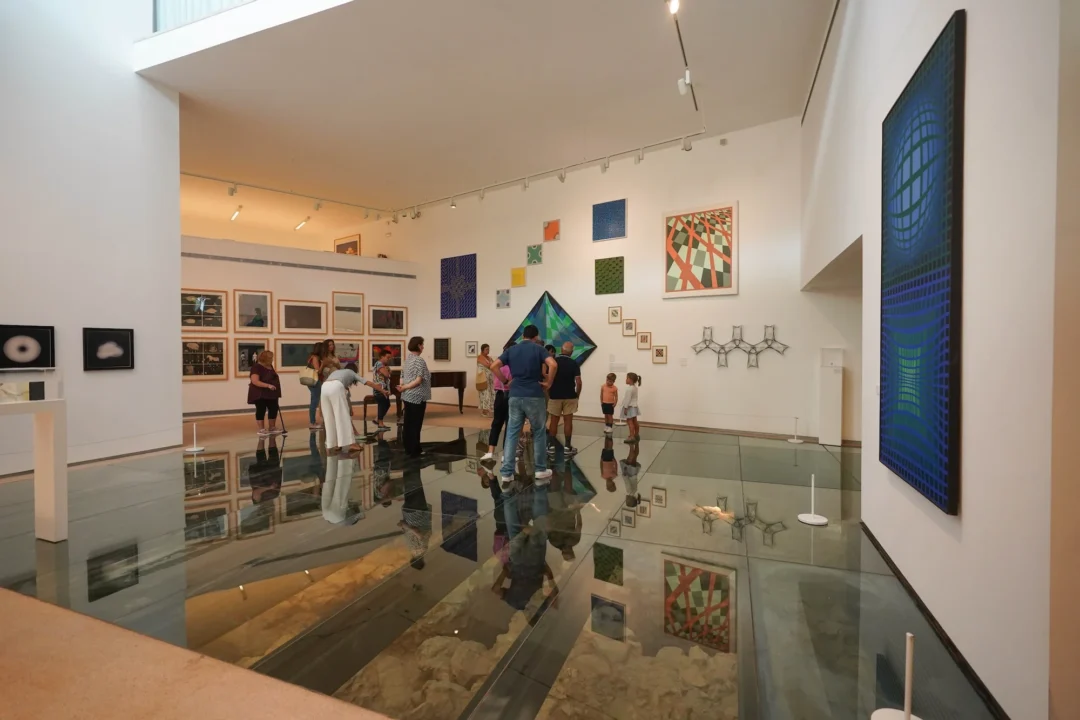
Just inside the walls, near the Portal de ses Taules, lies the Museu d’Art Contemporani d’Eivissa (MACE). Set among archaeological remains, the museum creates a strong contrast between contemporary creativity and historic surroundings.
MACE adds a cultural layer to the visit, showing that Dalt Vila is not frozen in time. Its exhibitions feature both local and international artists and offer a pause from the purely architectural route through the old town.
It connects Ibiza’s past with its present through contemporary art.
Plaza de España viewpoint: the first open panorama
Continuing uphill, the route reaches the Plaza de España, one of the first open viewpoints inside Dalt Vila. From here, visitors can look out over the port entrance, the Marina and the movement of boats below.
This square also acts as a key junction within the old town and is the access point to one of Dalt Vila’s lesser-known areas: Es Revellí.
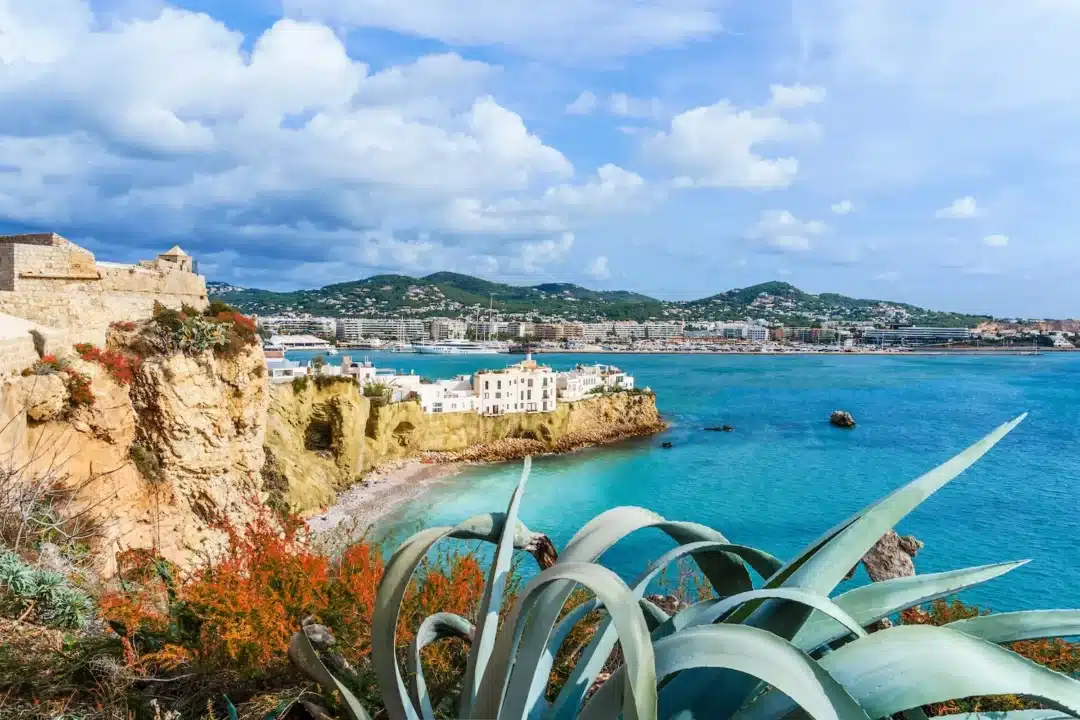
Es Revellí: the semi-bastion reclaimed by nature
Although Ibiza’s walls are often described as a fortress with seven bastions, the structure actually includes six main bastions and two semi-bastions: Santa Llúcia and Es Revellí. From an aerial view, the difference is clear: while the main bastions have a full arrowhead shape, these two retain only half of that form.
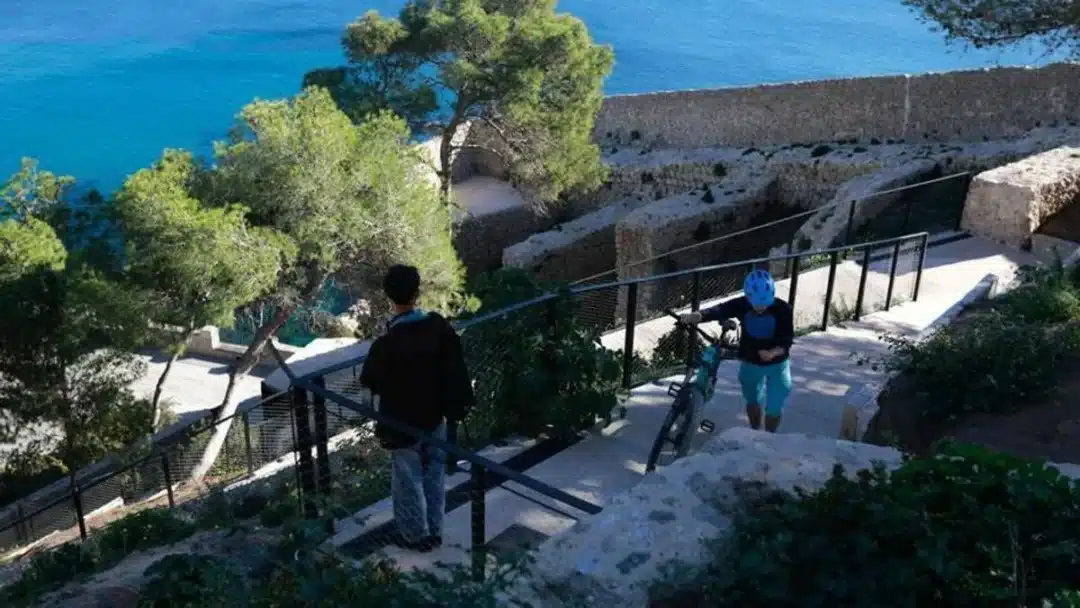
Es Revellí is the smaller and historically most overlooked of the two. For years, it remained hidden and overgrown. Recently reopened to the public via an entrance next to the Plaza de España viewpoint, it has been cleared of vegetation, its architectural elements restored and fitted with a zigzagging platform that climbs gently up the slope.
This short ascent offers unexpected views over the port, the rooftops of the Convent of Santo Domingo, s’Aranyet beach and the harbour. At the top, visitors are rewarded with a striking close-up view of the sharp vertex of Santa Tecla bastion, whose pointed tip seems to sink into the ground.
Baluard de Santa Llúcia: scale, cliffs and the city below
The route continues towards the Baluard de Santa Llúcia, the largest of the two semi-bastions. Despite its incomplete arrowhead shape, Santa Llúcia feels monumental. Its sharp edge and elevated position allow views across the entire neighbourhood of Sa Penya, the city and the port.
The reason for its ‘half-built’ form lies in geography. The missing side would have required reclaiming land from the sea, but the colossal cliff height above sa Penya beach already provided natural protection, making further construction unnecessary.
A powerful example of how military architecture adapts to the natural landscape.
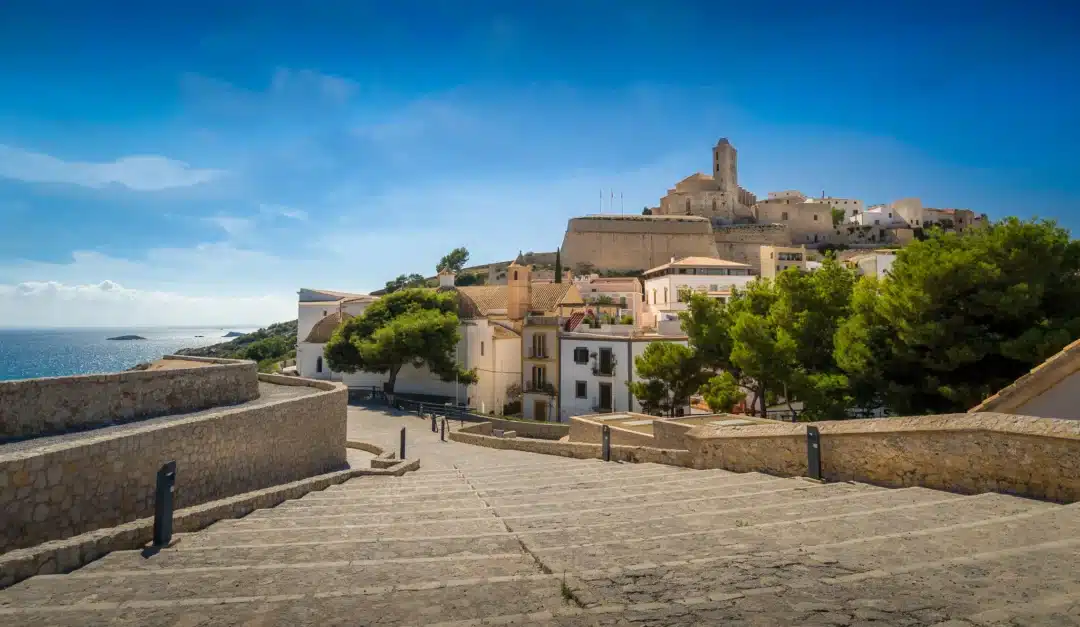
Plaza de la Catedral: the symbolic heart of Dalt Vila
At the highest point of the old town lies the Plaza de la Catedral, dominated by the Cathedral of Santa Maria. This open space feels calm and monumental, offering wide views over the coastline and surrounding hills.
The square acts as a natural resting point, where visitors often pause to take in the scale of Dalt Vila and the layers of history beneath their feet.
The Castle: Dalt Vila’s future Parador
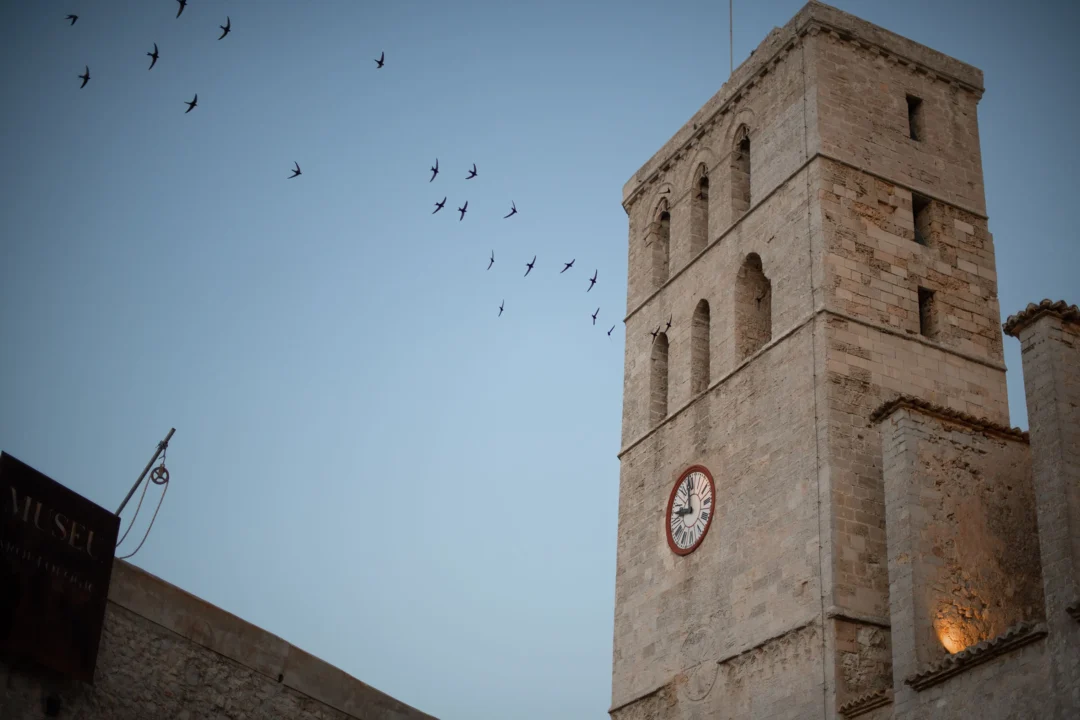
Just beyond the cathedral stands the castle, a historic fortress that will soon reopen as a Parador. Long closed to the public, it has always been a defining feature of Ibiza’s skyline.
Its transformation will add a new cultural and architectural dimension to Dalt Vila, reinforcing its role as a living heritage site rather than a static monument.
A symbol of Dalt Vila’s past and a key part of its future.
How to enjoy Dalt Vila at a relaxed pace
While Dalt Vila is built on slopes and cobbled streets, distances are manageable and the visit rewards slow exploration. Early mornings and late afternoons offer softer light and fewer crowds, especially in summer.
Comfortable footwear and water are recommended, but no special preparation is needed—this is a walk designed to be enjoyed, not rushed.
Why Dalt Vila is essential to understanding Ibiza
Exploring these corners of Dalt Vila offers more than views and photographs. It reveals how Ibiza has balanced defence, geography, daily life and culture over centuries. From monumental gateways to nature-wrapped bastions, Dalt Vila tells the story of the island from above.